
Evolution of Tandemly-Replicated Opsin Genes: Molecular Models That Predict Spectral Shifts

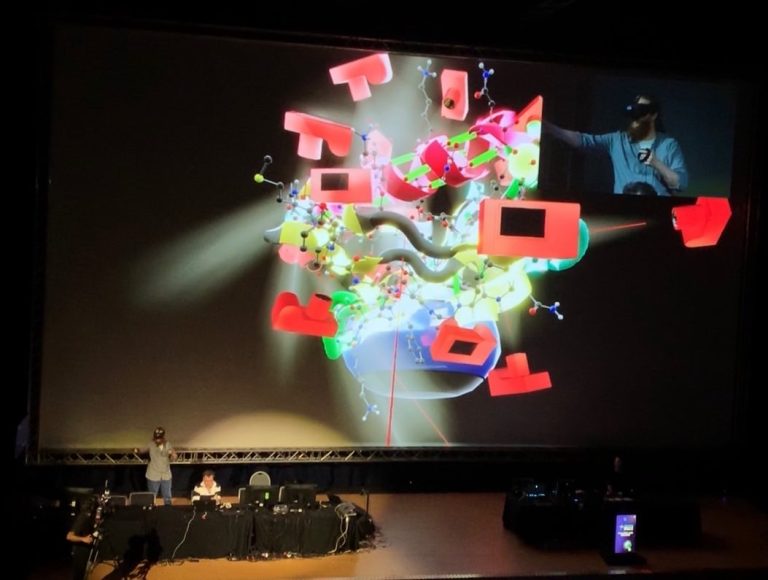
A snapshot from an atomistic molecular simulation of a vertebrate cone visual pigment (green – opsin, red – retinal, magenta – palmitoyl moiety) embedded in an explicit lipid bilayer (yellow & purple – lipid head group, grey – lipid tail) and surrounded by a layer of water molecules (cyan).


Working Group leader: Deborah Stenkamp

Group members: Jagdish Patel, Marty Ytreberg

Originated: Summer 2016

Description:

This working group on an as-needed basis, to discuss progress and approaches for modeling a set of tandemly-replicated cone opsins from the zebrafish, medaka, cichlid, and guppy. They selected these RH2-type cone opsins based upon the availability of a reasonable (reasonably homologous) model from an X-ray crystallography structure, and reliable information from the literature regarding sequence data and spectral sensitivity data.

Docking models attempted on these opsins did not predict spectral shift.

Standard all-atom molecular dynamics simulations were then performed to find out if these predict spectral shift. Challenges that were overcome included modeling of the covalently attached chromophore, and the influence of the surrounding lipid bilayer. In addition, we included three “ancestral” RH2 opsins with known spectral sensitivities to increase the scope of the study to seven RH2 opsins.

The molecular dynamics simulations were carried out in December 2016. Visualization of the distinct fluctuations and analysis of internal parameters associated with the chromophore’s heavy atoms suggested that some of these features may predict spectral shift, and quantitative/statistical approaches to determine if this is the case are underway.

RH2 cone opsins of medaka, guppy, and cichlid were added to the analysis to increase the robustness of our approach, providing a total of 14 distinct RH2 sequences. Two of the output metrics (RMSF and the C7-C6-C5-C18 Torsion) were identified as most highly predictive of “blue” vs. “green” peak spectral sensitivity. A mathematical model was generated, using these two parameters, which predicts spectral sensitivity with a correlative R2 of 0.94 (!!!!).

The manuscript was submitted in fall 2017 – to Cell, then PNAS, then PLOS Biology, and then eLife. The editorial staff at each journal considered it more appropriate for a specialty journal. In December 2017 we submitted it to PLOS Computational Biology. It was favorably reviewed, and after minor revisions, accepted. It is now published, with an epub date of January 24, 2018.

Publications:

Predicting peak spectral sensitivities of vertebrate cone visual pigments using atomistic molecular simulations

Patel JS, Brown CJ, Ytreberg FM, Stenkamp DL (2018) Predicting peak spectral sensitivities of vertebrate cone visual pigments using atomistic molecular simulations. PLoS Comput Biol 14(1): e1005974. https://doi.org/10.1371/journal.pcbi.1005974

Similar Posts

  • Geospatial Modeling (GM)

    Updated: February 2021 Working Group leader: Erich Seamon Group members: Bruce Godfrey, Claudio Berti, Paul Gessler, Raymond Dezzani, Jason Karl, Vincent Jansen, Marshall Ma, Luke Sheneman, Naveen Joseph, Alan Kolok, Daniel Cronan, Felix Liao, Jeff Hicke, Chao Fan Schedule: TBD Description: The Geospatial Modeling (GM) Working Group will explore and propose platforms and methodologies for performing spatially-explicit modeling across landscape…

  • |

    CMCI Calendar Updates

    If you have had recurring working group reservations in the Collaboratorium for the Spring 2018 semester, please be aware that most have ended and you will need to make a new reservation if you plan on meeting through the summer. You can see all current working groups on the CMCI calendar. If you would like…

  • |

    COVID-19 Modeling

    Working Group leader: Jennifer Johnson-Leung Group members: Ben Ridenhour, Craig Miller, Erich Seamon, Helen Brown, Dilshani Sarathchandra, Holly Wichman, Benji Oswald, Trevor Griffin, Tristan Moxley, Felino Macatuno, Tyler Meadows Originated: April 2020 Description: COVID-19 modeling, analysis, outreach, and community support.

  • Mathematical Immunology

    Working Group Leader: Tanya Miura. Esteban Vargas, Jean-Marc Gauthier Group members: Pallavia Deol, Eugenia Yeboah, Rodolfo Blanco Rodriguez, Benjamin Whipple Originated: November 8, 2022 Description: The Mathematical Immunology Working Group will develop mathematical models to explain the roles of immune responses during respiratory viral infections.

  • | |

    Reproducibility Does Not Equal Truth

    The CMCI Reproducibility in Sciences working group, or SciRep for short, has been meeting since the fall of 2015. Today, their most recent publication, “Scientific discovery in a model-centric framework: Reproducibility, innovation, and epistemic diversity,” was published in PLOS ONE. Congratulations! The American Council on Science and Health also picked up the story with their…

  • Epistasis

    Working Group leader: Dan Weinreich Group members: Tanya Miura, Andreas Vasdekis, Brenda Rubenstein, Craig Miller, David Morgan, Jagdish Patel, JT VanLeuven, Jonathan Barnes, Kyle Martin, Marty Ytreberg, Paul Rowley Originated: November, 2018 Description: This working group is interested in empirical and theoretical approaches for understanding epistasis and its evolutionary consequences.