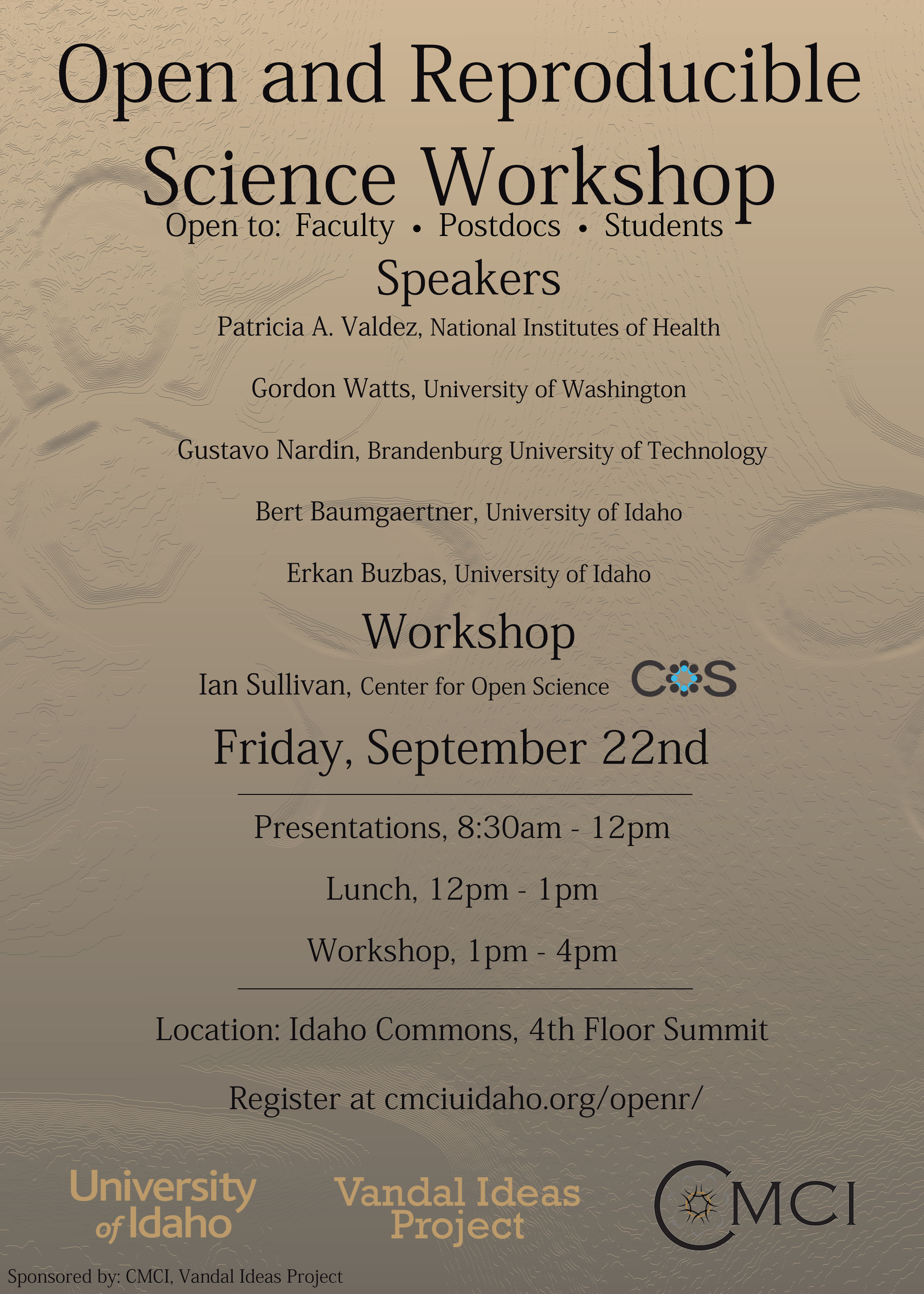

Open and Reproducible Science Workshop

Reproducibility of research results across repeated studies is a defining feature of science. However, in the last few years scientists across several fields including (but not limited to) psychology, cancer biology, biochemical science, preclinical research, ecology, and evolution have been facing difficulty reproducing well-known results in their respective fields. This disconcerting trend has resulted in widespread discussions of how to make science more reproducible and transparent. Our workshop will include talks by external and internal speakers providing different perspectives on scientific reproducibility, and will include hands on training by the Center for Open Science on many simple actions researchers can take to increase the reproducibility of their work.

Presentation material from the workshop

Center for Open Science Workshop

Reproducibility Theory, Social Aspects, and Practice of

NIH Perspective on Rigor and Reproducibility: Patricia Valdez

Reproducibility and Open Science: Gordon Watts

Reproducible Science: Gordon Watts

Similar Posts

  • Fall 2019 Seminar Series

    We have four great speakers lined up to deliver talks for the fall seminar series: Nickolas Banovich, Translational Genomics Research Institute (TGen) (hosted by Audrey Fu) Rustom Antia, Emory University (hosted by Jim Bull) Kayla Hardwick, Phylos (hosted by BCB student Bob Week) Wolfgang Banzhaf, Michigan State (hosted by James Foster) If you would like…

  • Fall 2015 Seminar Series

    Integrated inferences of demography and selection from population genetic data Sohini Ramachandran, Center for Computational Molecular Biology Brown University Tuesday, November 17, 2015, 3:30 pm Location: Life Sciences 277 Dynamical systems with random switching and application to brain biochemistry and insect physiology Sean Lawley, University of Utah Thursday, November 19, 2015, 3:30 pm Location: Life…

  • Data Carpentries Training

    IMCI is sponsoring the University of Idaho as a member organization in The Carpentries training program to improve data literacy and reproducible science. The Carpentries teaches foundational computational and data science skills to researchers worldwide. They train and certify volunteer instructors and provide curriculum in a variety of topics designed to be presented as workshops….

  • Aaron King Seminar

    Dr. Aaron King, a professor at the University of Michigan, will present the first IBEST/CMCI Seminar of the semester on Thursday, January 24 at 12:30 p.m. in LSS 277. Dr. King is interested in studying evolution and ecology at long temporal and spatial scales using stochastic approaches. He’s done work on disease modeling and method/model/software…