25 CMCI Supported Publications to Date
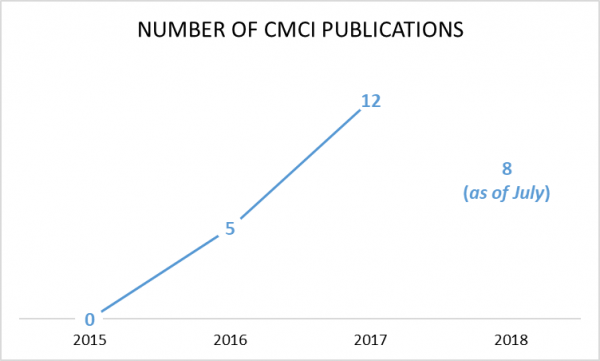
Since our inception in 2015, CMCI has seen an increase each year in the number of articles published.
To view a full list of titles published with links to the full articles, click here.


Since our inception in 2015, CMCI has seen an increase each year in the number of articles published.
To view a full list of titles published with links to the full articles, click here.

Congratulations! Bert Baumgaertner, Florian Justwan and Juliet Carlisle, who are part of The Social Determinants of Infectious Disease Dynamics working group, had their research published in the Public Library of Science One (PLOS ONE) yesterday. Their paper is titled “The Influence of Political Ideology and Trust on Willingness to Vaccinate.” Read the University of Idaho press release…

Dr. Benjamin Ridenhour, Assistant Professor in the Department of Mathematics and Statistical Science and IMCI modeler, recently made significant contributions to an article in The Scientist, a magazine for life science professionals: Read the entire article, written by Katarina Zimmer, here.

This article was written by Leigh Cooper in University of Idaho Communications and Marketing. View the original article here. While IMCI was not involved in the funding of this research project, we are are thrilled to count Dr. Ryan Long as one of our participating faculty. MOSCOW, Idaho – October 17, 2019 – A University…

College of Science faculty Jessica Lee, Siavash Riazi, Shahla Nemati, Jannell Bazurto, Andreas Vasdekis, Benjamin Ridenhour, Christopher Remien and Christopher Marx had a paper published in PLOS Genetics. In their research, they uncovered that genetically identical cells can be phenomenally different in their ability to survive stress, and thus selection acts upon the distributions of…
This news article was written by Kathy Foss, Marketing and Communications Manager for the College of Letters, Arts and Social Sciences. Drs. Florian Justwan and Bert Baumgaertner are active CMCI faculty participants and part of the Social-Epi working group. MOSCOW, Idaho — Aug. 28, 2019 — People skeptical of the medical establishment who live close to…
Vakanski A, Ferguson JM, Lee S. Mathematical Modeling and Evaluation of Human Motions in Physical Therapy Using Mixture Density Neural Networks. J Physiother Phys Rehabil. 2016 Dec;1(4):118. Epub 2016 Oct 11. PMID: 28111643; PMCID: PMC5242735. https://pubmed.ncbi.nlm.nih.gov/28111643/