25 CMCI Supported Publications to Date
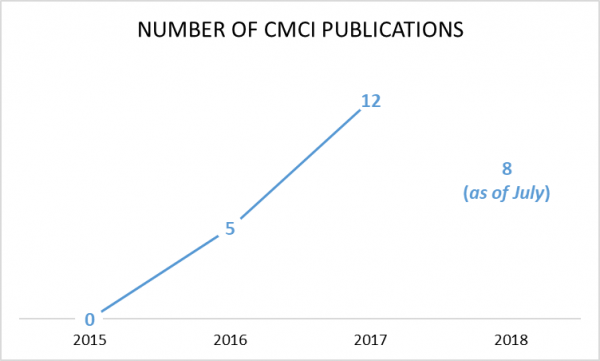
Since our inception in 2015, CMCI has seen an increase each year in the number of articles published.
To view a full list of titles published with links to the full articles, click here.


Since our inception in 2015, CMCI has seen an increase each year in the number of articles published.
To view a full list of titles published with links to the full articles, click here.

Congratulations to Jagdish Patel and Marty Ytreberg! Their article, “Expanding the watch list for potential Ebola virus antibody escape mutations” was recently selected to be featured on the PLOS Ebola Channel. The PLOS Ebola Channel was launched in response to the ongoing Ebola outbreak in the Democratic Republic of Congo. They work with authors and…

Where does a cell put it’s resources? CMCI participant and Department of Physics faculty member Andreas Vasdekis, and his research colleagues Hamdah Alanazi, Amrah Canul and Christopher Williams published a study in the journal Nature Communications. They introduce a new imaging technique to record how a single cell allocates its resources between the production of…

Congratulations! Bert Baumgaertner, Florian Justwan and Juliet Carlisle, who are part of The Social Determinants of Infectious Disease Dynamics working group, had their research published in the Public Library of Science One (PLOS ONE) yesterday. Their paper is titled “The Influence of Political Ideology and Trust on Willingness to Vaccinate.” Read the University of Idaho press release…
Congratulations to IMCI participants on their recent publication in PLOS Medicine. The following news story was produced by the Mountain West News Bureau. View the original article here. A newly published study out of the University of Idaho suggests that the higher perceived risk of a disease, the more likely someone is to vaccinate. The researchers surveyed…
The cover of Science Magazine currently features an important discovery made by an international research team: deep-sea fish can see more than just one color. When a Switzerland- and Australia-based research team recently needed to validate their findings regarding what colors of light a deep-sea fish species could see at up to 1500 meters below…
Vakanski A, Ferguson JM, Lee S. Mathematical Modeling and Evaluation of Human Motions in Physical Therapy Using Mixture Density Neural Networks. J Physiother Phys Rehabil. 2016 Dec;1(4):118. Epub 2016 Oct 11. PMID: 28111643; PMCID: PMC5242735. https://pubmed.ncbi.nlm.nih.gov/28111643/