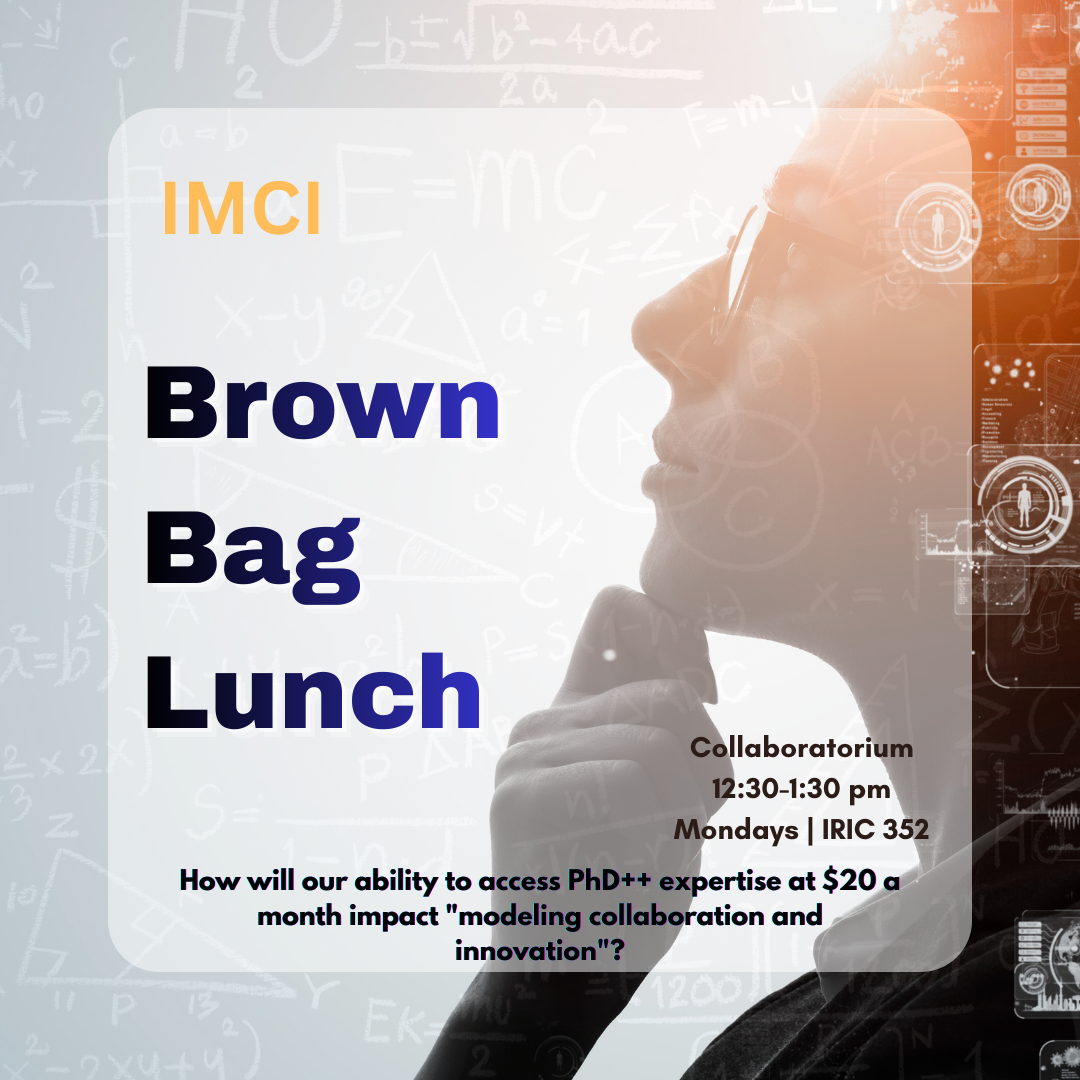
Brown Bag Lunch: How will our ability to access PhD++ expertise at $20 a month impact “modeling collaboration and innovation”?
Zoom: https://uidaho.zoom.us/j/81951581577
Pass: 4321
The landscape is changing with the rise of AI! What part will we play in the shaping of our future with it?
We are very excited to announce two of our upcoming Brown Bag Lunches, the first happening Monday, February 23, from 12:30-1:30 pm, in the Collaboratorium (IRIC 352).
Come join us as Bert Baumgaertner takes the lead on this discussion with his talk, titled: How will our ability to access PhD++ expertise at $20 a month impact “modeling collaboration and innovation”?
Let’s briefly consider the state of the art in AI the past few years. In 2022 we had unreliable basics: AI could not reliably perform basic arithmetic (e.g., it would confidently state that 7 × 8 = 54). In 2023 it gained some academic competence (AI was capable of passing the bar exam) but still suffed from major reliability issues (prone to “hallucinations,” and confidently stated nonsense). In 2024 we started to see more advanced knowledge: AI could explain graduate-level science and could do some functional coding, moving from making errors to writing working software. In 2025 we saw significant progress acceleration and time between model releases shortened. By late 2025, elite software engineers began handing over the majority of their coding work to AI. And now just a week or so ago in 2026, we see autonomous development: Models like GPT-5.3 Codex and Opus 4.6 can build entire apps from plain English descriptions. This includes writing tens of thousands of lines of code, opening the app, clicking buttons to test features, and iterating on the design without human intervention. It is exceeding experts: In specific benchmarks (like the METR organization’s data), AI can complete tasks that take a human expert nearly five hours. Given that AI is now instrumental in creating the next version of itself, including debugging its own training and managing deployment, there is good reason to believe it will continue advancing its ability to display “intelligent decisions” and an inexplicable sense of what the right call is, moving beyond just technical execution. Rather than be gloomy about this prospect, this BBL will invite us to identify opportunities for collaboration and innovation in a time where PhD++ knowledge is cheap and plentiful.
We really hope to see you there!