
Modeling Gut Microbial Dynamics
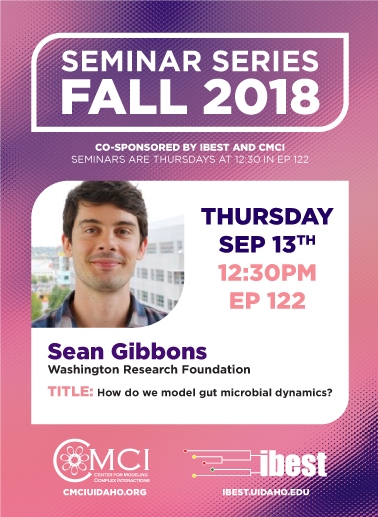
Join us for the next joint-hosted IBEST/CMCI seminar on Thursday, September 13, 12:30 p.m. in EP 122. Sean Gibbons from the Washington Research Foundation will present, “How do we model gut microbial dynamics?“
Abstract:
Dynamics reveal crucial information about how a system functions. However, it is not yet known what the relevant timescales or models are for understanding microbial dynamics in the gut. For example, gut microbial population dynamics may be largely internal, and the stool samples we obtain likely represent the end-point of these internal dynamics. In this talk, I describe a statistical approach for disentangling different components of dynamics within the human gut microbiome: autoregressive and non-autoregressive. Autoregressive dynamics involve recovery from large deviations in community structure. These recovery processes appear to involve the blooming of facultative anaerobes and aerotolerant taxa, likely due to transient shifts in redox potential, followed by re-establishment of obligate anaerobes. Non-autoregressive dynamics carry a strong phylogenetic signal, wherein highly related taxa fluctuate coherently. These non-autoregressive dynamics may be driven by external, non-autoregressive variables like diet. Most of the community variance is driven by day-to-day fluctuations in the environment, with occasional autoregressive dynamics as the system recovers from larger shocks. Despite frequently observed disruptions to the gut ecosystem, there exists a strong returning force that continually pushes the gut microbiome back towards its steady-state configuration.
Check out the Gibbons Lab website here.