News: Deep-sea fish reveal an alternative developmental trajectory for vertebrate vision
Patel Lab Study Reveals a New Pathway in Vertebrate Vision
What do deep‑sea fish see that we don’t? What deep‑sea fish eyes see has long fascinated scientists. Their larvae, developing in pitch‑black waters, offer a rare window into observable evolutionary processes—helping us understand not only how they see, but how vision evolved in all vertebrates, including us.
A new study led by Assistant Professor Jagdish Patel and former U of I postdoc Jonathan Barnes is making waves in the field, proposing an alternative developmental pathway for vertebrate vision. This work challenges long‑held assumptions about how eyes develop and how light‑sensing cells evolve.
For more than a century, vertebrate sight has been explained through two main photoreceptors, cones, which detect bright light and color, and rods, which enable dim‑light and night vision
The classical view holds that cones develop first, forming dominant early retinas, and rods emerge later as the organism matures. This timeline has been largely accepted as universal—regardless of environment. But what happens when the environment is permanently dark?
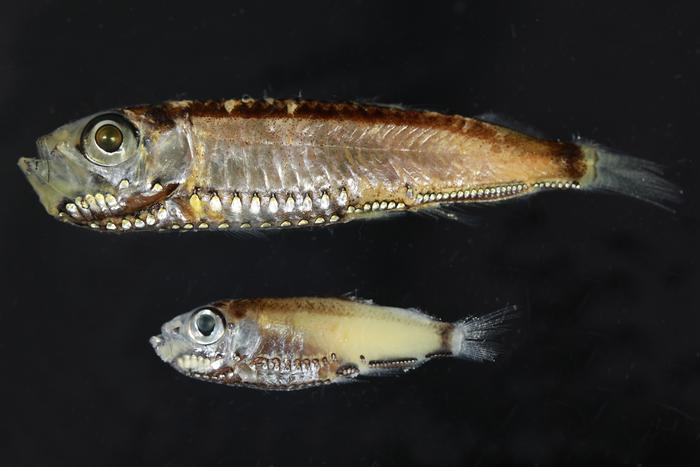
In March 2018, while aboard the Al Zizi in the Arabian Red Sea, researchers collected larvae from three species of deep‑sea fish. These specimens were then taxonomized, imaged, and carefully enucleated to study the retina at different developmental stages.
Over the following years, Patel, Barnes, and collaborators generated an unprecedented dataset. Their 2026 publication reveals something extraordinary: deep‑sea fish larvae do not follow the traditional cone‑first pathway. Instead, these species appear to adopt a rod‑first developmental strategy—a radical shift that aligns with the perpetual darkness of their habitat.
This discovery shakes the foundation of a century and a half of thinking about vertebrate eye development. If rods can develop first in some species, it suggests that retinal development is far more flexible and environmentally responsive than previously understood.
The implications extend far beyond fish biology. This finding opens the door to new hypotheses about, how vertebrate vision evolves, how sensory systems adapt to extreme environments, and what developmental plasticity looks like across species.
It may even influence biomedical studies of human retinal development and degenerative eye diseases.
We want to take a moment to congratulate Dr. Jagdish Patel on this exciting research and its successful publication.
Full access to the research can be found here: https://www.science.org/doi/10.1126/sciadv.adx2596
Lily G. Fogg et al. (2026). Deep‑sea fish reveal an alternative developmental trajectory for vertebrate vision. Science Advances, 12, eadx2596. DOI: 10.1126/sciadv.adx2596