Writing Working Group (Writing WG)
Come join the Writing Working Group on Tuesdays @1:30-4:30pm in the Collaboratorium (IRIC 352) for a consistent and accountable time and place to write!


Come join the Writing Working Group on Tuesdays @1:30-4:30pm in the Collaboratorium (IRIC 352) for a consistent and accountable time and place to write!
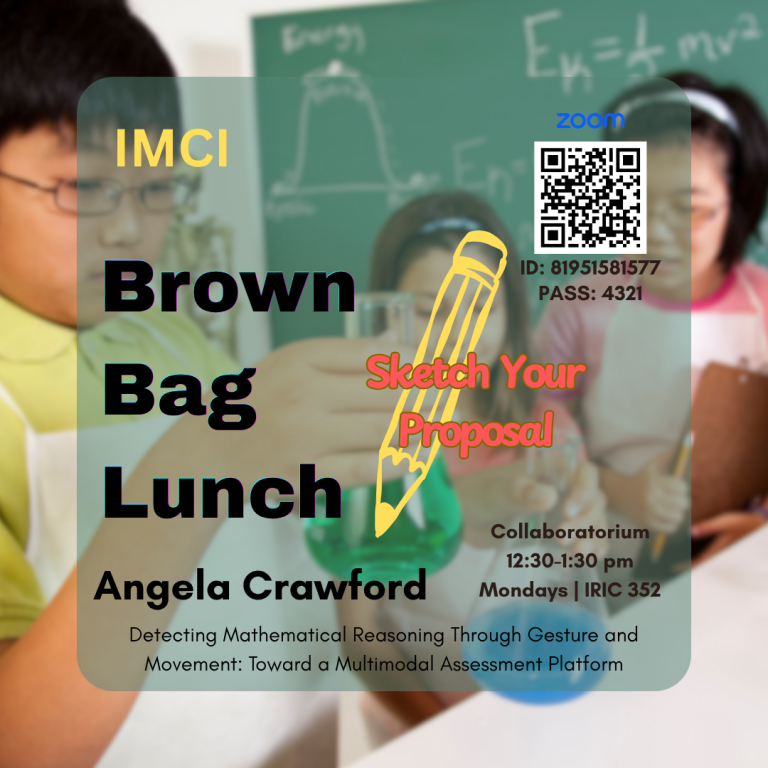
Our next Brown Bag Lunch, Sketch Your Proposal session is happening Monday, April 13, from 12:30-1:30 PM in the Collaboratorium (IRIC 352). How do students communicate mathematical reasoning they can’t yet put into words? Join the conversation as Angela Crawford, an Assistant Research Professor of STEM Education, investigates behavioral signals, such as gesture and student-generated inscriptions, of proportional…

The Institute for Modeling Collaboration and Innovation hosts Data Carpentries workshops each semester to improve data literacy and reproducible science. The Carpentries teaches foundational computational and data science skills to researchers worldwide. The spring workshop, Genomics in Unix and R, is quickly approaching but there is still space for participants to join. Attendees may register for U of…
Johan Paulsson, of Harvard Medical School will be joining us, with his talk titled: Single-cell and evolutionary approaches to basic microbial physiology and diagnostics. More details to come on that talk as we get closer. We are excited to have Johan coming from such a distance to speak to the IMCI community! Zoom Link: https://uidaho.zoom.us/j/81951581577 Meeting ID: 81951581577…
All IMCI and IBEST participants, including faculty, postdocs, students and staff, are invited to participate in an extraordinary brainstorming session on January 30 and again on February 6 in the Clearwater room at the ISUB. The idea is that rather than assemble research teams in response to specific funding opportunities, researchers grow teams with common…
This coming Monday, we will be joined by Onesmo Balemba when he presents his talk:Specific Phocaeicola vulgatus strains link dysbiosis of gut microbiota to the pathogenesis of gastrointestinal nerve cell damage and impaired motility in type 2 diabetes. We are very excited to have him! While you are away enjoying your weekend, keep us in mind when…
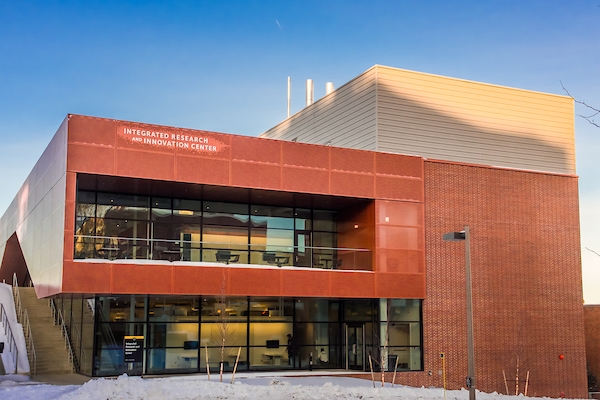
Event: CMCI Brown Bag Lunch Date: Monday, November 12 Time: 12:30 – 1:30 p.m. Place: Collaboratorium, IRIC 352 Talk: “Performance of a bacterial cell as an energy conversion device in terms of energy-return-on-investment determined from atomic-detail structural models,” presented by Melih Sener, Theoretical and Computational Biophysics Group, Beckman Institute, UIUC, https://www.ks.uiuc.edu/~melih/ Abstract: Bioenergetic…