Events | Get Involved | News

Similar Posts
Fall Break (11/24 – 11/28)
Greetings IMCI crew, The University of Idaho will adjourn for the week of 11/24 for Fall Break. IMCI will continue to support our collaborators as usual—though all IMCI events will be postponed until the semester resumes.
Intellectual Property 101
On Monday, August 19, 2019, Jeremy Tamsen, Director of Office of Technology Transfer, talked about intellectual property at the Brown Bag Lunch. For your use and reference, here are the slides from his presentation.
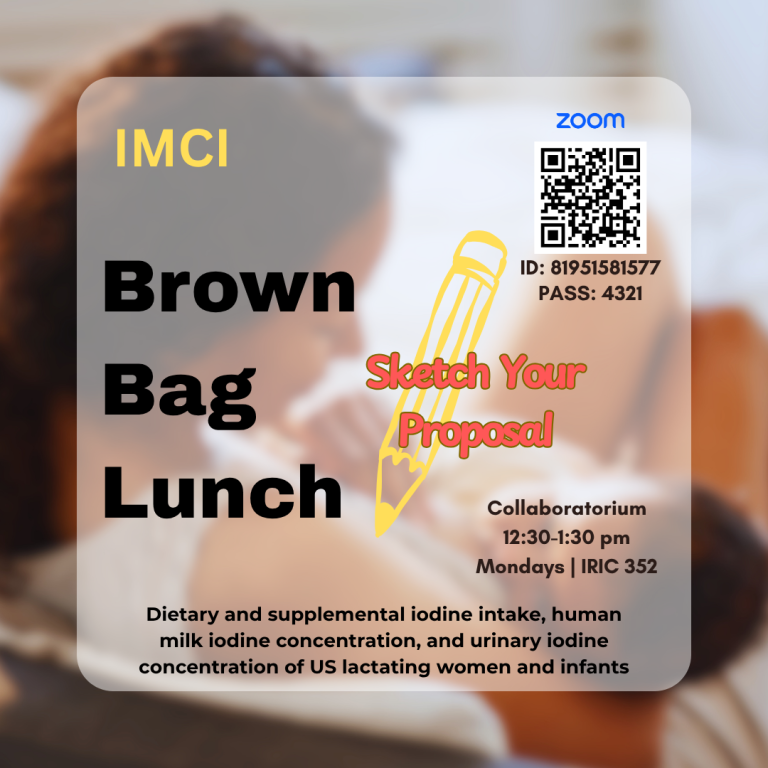
Brown Bag Lunch: Sketch Your Proposal – Adrianne Griebel-Thompson: Dietaryand supplemental iodine intake, human milk iodine concentration, and urinary iodine concentration of US lactating women and infants.
This is an announcement of our upcoming Brown Bag Lunch happening Monday, April 6, from 12:30-1:30 PM in the Collaboratorium (IRIC 352). Join us for our first of many Sketch Your Proposal (SYP) sessions—starting with Adrianne Griebel-Thompson‘s, titled: Dietary and supplemental iodine intake, human milk iodine concentration, and urinary iodine concentration of US lactating women and infants. These…
Brown Bag Lunch Series: From Genes to Epidemics: Integrating Machine Learning and Mechanistic Models
Bring a lunch and come join the crew as Chenangnon Tovissode presents a mock job talk. His topic is “From Genes to Epidemics: Integrating Machine Learning and Mechanistic Models“. In this presentation, Chenangnon will explore two complementary approaches to investigating causal mechanisms in biological and social systems. The first part focuses on uncovering causal pathways from…
Dr. Michael Burnam-Fink at Brown Bag Lunch
Dr. Michael Burnam-Fink will be the featured speaker at our weekly CMCI Brown Bag Lunch on Monday, September 10. His talk is titled “Visualizing Collaboration: Interactive Bibliometric Network Mapping for Evaluating Interdisciplinary Research Groups” and will take place at 12:30 in the Collaboratorium, IRIC 352. Michael is an instructor at Arizona State University and holds…